
When designing an electrical installation, choosing the right cable section is one of the most important decisions you make. A cable that is too small can overheat, cause too much voltage drop, or prevent safety devices from functioning properly. On the other hand, a cable that is too large is unnecessarily expensive and often makes the installation more difficult to execute.
A correct cable calculation is therefore not a luxury, but an essential part of a safe, reliable, and compliant electrical installation.
Why is cable calculation important?
The cable forms the connection between the power supply and the consumer. During the transport of electrical energy, losses always occur. The larger the current and the longer the cable, the more important the correct cable choice becomes.
A correct cable calculation ensures that:
- the cable can safely carry the operating current;
- the cable does not overheat;
- the voltage drop remains within the permitted limits;
- the safety device can work correctly in the event of a fault or short circuit;
- the installation meets the requirements of the AREI;
- unnecessary costs due to oversized cables are avoided.
A correct cable section not only increases safety but also ensures a technically and economically optimal installation.
What factors determine the cable section?
Many people think that the cable section depends solely on the current strength. In reality, many parameters play a role.
Some important factors are:
- the power or operating current of the consumer;
- the supply voltage;
- single-phase or three-phase power supply;
- the cable length;
- the cable material (copper or aluminum);
- the installation method;
- the ambient temperature;
- the grouping of multiple cables;
- the insulation material used;
- the maximum permissible voltage drop;
- the chosen safety device.
All these factors influence the maximum permissible current load of a cable. That's why a professional cable calculation is often much more complex than a simple lookup in a table.
Common mistakes
In practice, we regularly see the same mistakes:
- the cable length is forgotten, causing the voltage drop to become too large;
- the installation method is not applied correctly;
- correction factors for temperature or cable grouping are ignored;
- the safety device is chosen before the cable calculation instead of after;
- one chooses a much too large cable "for safety", which causes unnecessary costs.
By systematically taking all these factors into account, you avoid surprises during execution or during inspection.
Cable calculations don't have to be complicated
Those who regularly perform cable calculations know how much data needs to be checked. Consulting tables, applying correction factors, and comparing different options can quickly take a lot of time.
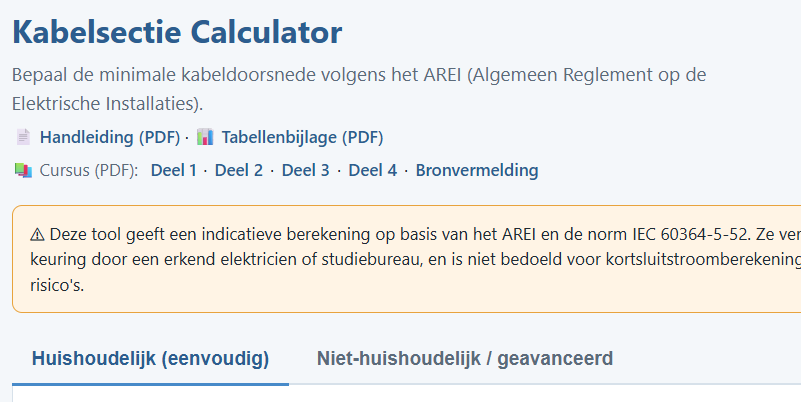
That's why we've developed a new online cable calculation tool. This tool guides you step by step in determining the correct cable section and takes into account the most important parameters that influence the calculation.
The tool is currently available as a Beta version. This means that we are still refining and expanding the application. User feedback is therefore particularly welcome. Based on practical experience, additional functions will be added and existing calculations will be further optimized.
With the online cable calculation tool, you can also find a link to a manual and several links to a simplified course on Cable Dimensioning and Electrical Installations (4 parts).
Whether you are a student, installer, designer, or inspection expert, the tool helps you to quickly come to a correct and substantiated cable choice.
From theory to practice
The online cable calculation tool helps you quickly determine the correct cable section. Do you also want to understand how the calculation is made and what influence factors such as installation method, ambient temperature, voltage drop, and short-circuit currents have? Then be sure to take a look at our free courses:
- Cable Dimensioning and Electrical Installations
- Part 1: Basic Principles of Electrical Installations
- Part 2: The Standards: AREI, IEC 60364 and related IEC standards
- Part 3: Refinements and limitations of the model
- Part 4: Practical cases
- Table appendix
- Manual
Together with the cable calculation tool, these courses form a complete reference work for students, installers, and designers.
Try the cable calculation tool yourself
Are you curious about which cable section is suitable for your application? Test our new online cable calculation tool and discover how quickly you can perform a correct calculation.
👉Online cable cross-section calculator
Since the tool is still in the Beta phase, we appreciate all comments and suggestions. Together, we can further improve and expand the application into a reliable reference for everyone who works with electrical installations.
A correct cable calculation is not only a legal obligation, but above all an investment in a safe, sustainable, and professional installation.