
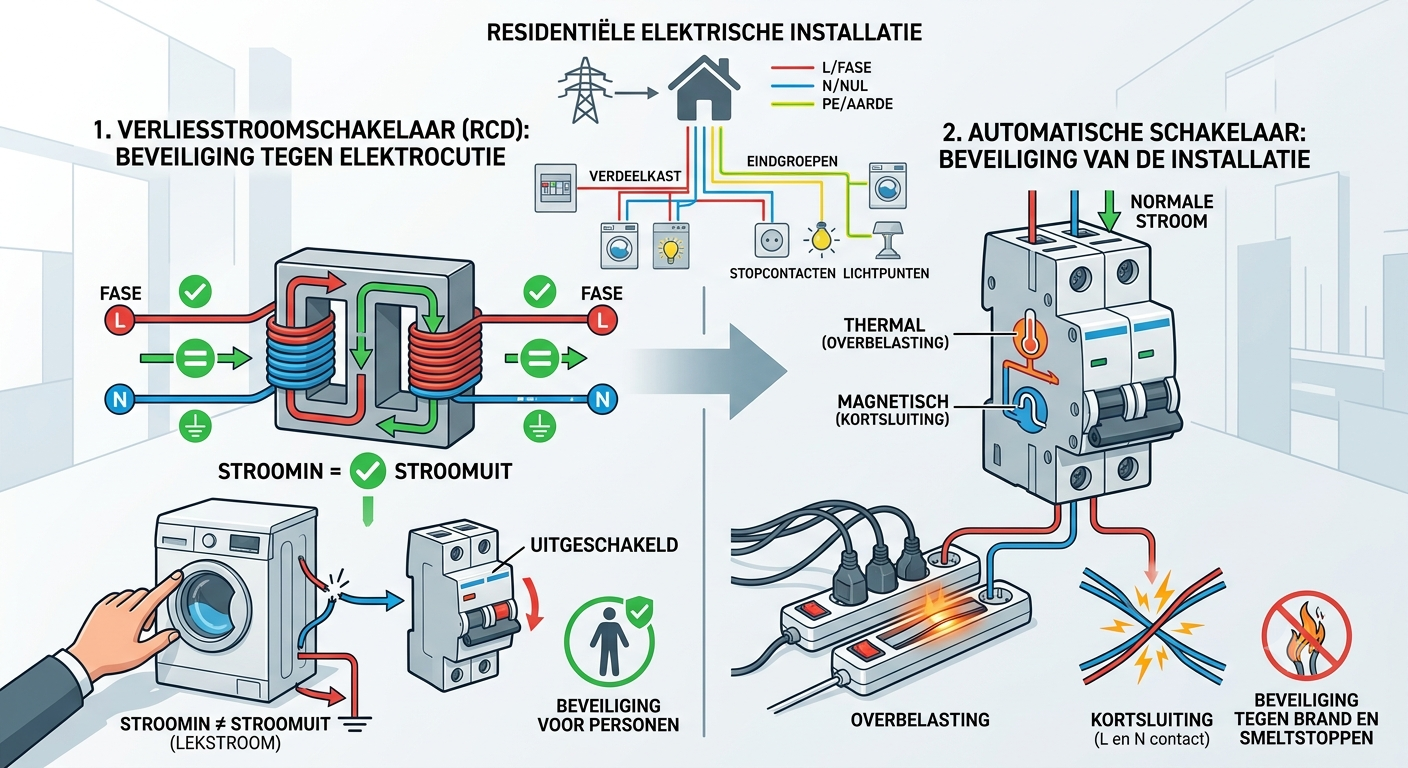
A safe electrical installation relies on several safeguards, each with its own task. Two of the most important are the differential switch (also called a residual current device or RCD) and the automatic installation switch (automatic fuse). Although they are often placed side by side in a distribution board, they protect against totally different hazards.
In this article, we explain how both safeguards work, why they are indispensable in every residential installation, and how a correct electrical diagram helps to make these safeguards clear.
How does a differential switch work?
The task of a differential switch is to protect people from electrical shocks and limit the risk of fire due to leakage currents.
The switch continuously checks whether the current flowing through the phase wire to an electrical circuit returns completely through the neutral wire. For this, it uses a ring core transformer that compares both currents.
Normal operation
Under normal conditions, the current flowing through the phase is exactly equal to the current returning through the neutral. There is therefore no difference between the two currents, and the differential switch remains switched on.
When does a leakage current occur?
If a device becomes defective, part of the electrical current can take a different path. This can happen, for example, via:
- a metal housing that becomes live;
- the protective conductor (PE);
- the ground;
- or, in the worst case, via a person touching the device.
This means that not all current returns through the neutral wire, and a difference arises between the outgoing and return current.
Automatic disconnection
As soon as this difference becomes greater than the set sensitivity, the differential switch disconnects the power almost immediately. With a sensitivity of 30 mA, this usually happens within a few tens of milliseconds.
Thanks to this rapid response, the risk of a dangerous electrical shock is significantly reduced.
Practical example
Suppose a hair dryer consumes a current of 5 A.
Normal situation:
- Via the phase, 5,000 A leaves.
- Via the neutral, 5,000 A also returns.
- Difference: 0 A.
If, due to a defect, 50 mA flows away via the ground:
- Phase: 5,000 A
- Neutral: 4,950 A
- Difference: 0.050 A (50 mA)
A differential switch with a sensitivity of 30 mA will switch off immediately in this situation.
Why is 30 mA usually used?
A sensitivity of 30 mA is chosen because smaller leakage currents are often normal or harmless, while currents from about 30 mA - depending on the contact duration and current path through the body - can have serious physical consequences.
Therefore, sockets, bathrooms, washing machines, outdoor installations, and most final circuits in homes are usually protected by a 30 mA differential switch.
In addition, in many residential installations, a 300 mA differential switch is also used as the main protection. This is primarily intended to limit the risk of fire due to insulation faults and not as personal protection.
What does a differential switch not do?
A common misconception is that a differential switch solves all electrical problems. That is not the case.
It does not protect against:
- overload;
- short circuit.
For these hazards, another safeguard is needed: the automatic installation switch .
How does an automatic installation switch work?
An automatic switch protects the electrical wiring against overloads and short circuits. It checks not whether current is leaking to ground, but whether the current through the circuit becomes too high.
For this, it uses two separate protection mechanisms.
Thermal protection
The first protection consists of a bimetallic strip.
If a higher current flows through the circuit for a longer period than it is designed for, this strip heats up. Due to the temperature increase, the bimetal bends and the automatic switch turns off.
The greater the overload, the faster this happens.
Example
A circuit is protected by a 16 A automatic switch.
If several heavy electrical devices are used at the same time, the current may rise to around 20 A, for example. After some time, the automatic switch will switch off so that the wiring does not overheat.
Magnetic protection
In addition to thermal protection, the automatic switch also contains an electromagnetic coil.
In the event of a short circuit, the current rises to a very high value in a fraction of a second. The electromagnet immediately activates the switch-off mechanism, causing the current to be interrupted almost immediately.
This prevents serious damage to the installation and connected devices.
Example
If the phase and neutral wires come into direct contact with each other, the short-circuit current can be hundreds or even thousands of amperes. The automatic switch will then switch off within a few milliseconds.
B- and C-characteristics
In residential installations, automatic switches with a B-characteristic are usually used.
- B-characteristic: switches off magnetically between 3 and 5 times the nominal current. Ideal for lighting and normal sockets.
- C-characteristic: switches off between 5 and 10 times the nominal current. Suitable for devices with a higher switching current, such as certain motors or compressors.
Together they form a safe installation
Both safeguards complement each other.
A differential switch protects people, detects leakage currents, and switches off when there is current to ground
An automatic installation switch protects wiring, detects overloads, and switches off when the current is too high
Some practical examples:
- A defective electric kettle where the metal housing becomes live → the differential switch switches off.
- Too many electric heating devices on the same circuit → the automatic switch switches off.
- A damaged cable where the phase and neutral touch each other → the automatic switch switches off almost immediately.
Neither of the two safeguards can replace the other. Together, they ensure that an electrical installation remains safe for both the user and the installation itself.
Why a correct electrical schema is important
A safe electrical installation does not start only with the right safeguards, but also with clear and correct documentation.
On a single-line diagram and situation diagram, it must be clearly visible which circuits are protected by which differential switches and automatics switches. This is not only important for an AREI (GREI) inspection, but also for maintenance, extensions, and quickly detecting faults.