
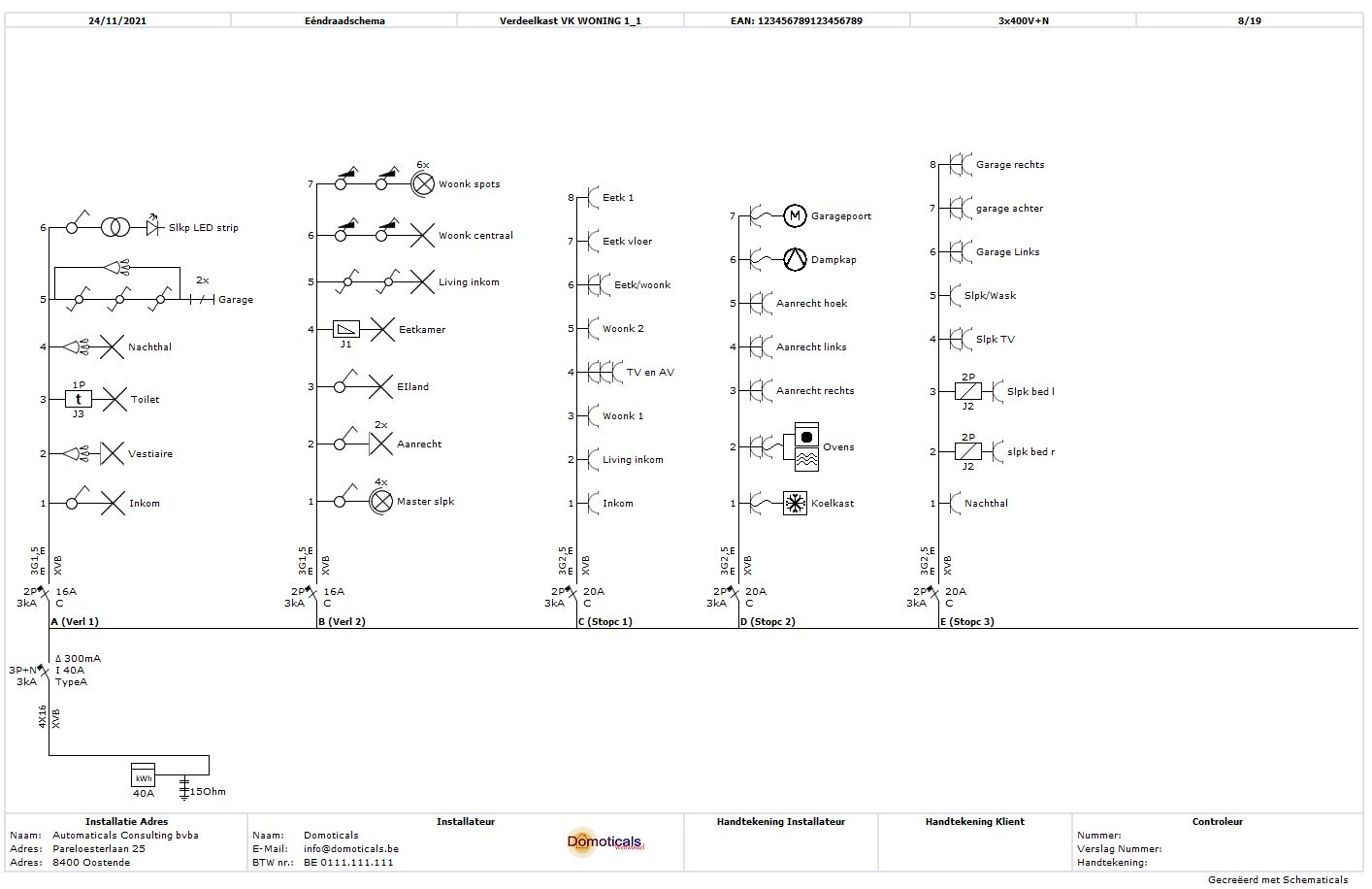
The preparation of a correct single-line diagram is compulsory for every new electrical installation and for every significant modification or extension in Belgium. According to the GREI (General Regulation on Electrical Installations), this diagram forms one of the most important documents of the complete electrical dossier.
In this blog, we clearly and practically explain what exactly needs to be on a single-line diagram, so you can be sure that your installation meets the inspection requirements.
What is a single-line diagram?
A single-line diagram is a technical overview of the complete electrical installation, where all power circuits are represented schematically with one line per circuit.
The goal is simple: ✅ in one glance, show how the electrical installation is built and secured.
Mandatory content of a single-line diagram (GREI)
According to the AREI, a correct single-line diagram must contain at least the following elements:
1. Clear division of power circuits
- Each power circuit must be indicated with a unique letter (A, B, C, …)
- All circuits must be logically built from the protection
2. Automatic and manual consumers
On the diagram, all electrical points must be correctly mentioned:
- light points
- sockets
- switches
- control or control elements
✅ Each element receives a unique sequence number per circuit, starting from the protection.
3. Protections and distribution equipment
The single-line diagram must clearly show:
- automatic fuses (automatons)
- differential switches
- distribution boards
- possible additional protections
✅ This is essential for the GREI inspection.
4. Technical data of the installation
On the single-line diagram, the basic parameters must also be mentioned:
- voltage (e.g. 230V / 400V)
- type of current (single-phase or three-phase)
- nature of the installation
5. Identification of the file
Each single-line diagram must compulsorily contain:
- name of the executor of the works
- capacity (installer, contractor, etc.)
- possibly VAT number
- address of the installation
- date and version of the diagram
✅ This is crucial for the inspection and traceability.
6. Correct numbering and logic
The structure must be strictly logical:
- numbering always starts at the protection
- each consumption point receives a unique number
- the relationship between circuit and consumer must be clear
7. GREI symbols
All components must be represented with:
- official GREI symbols
- or clearly defined alternative symbols (with legend)
✅ Without correct symbols, a diagram can be rejected.
Changes and extensions
In the event of a significant modification or extension, it is always necessary:
- to draw up a new single-line diagram
- to update the entire file
For minor changes, a description may be sufficient, but the diagram must remain up-to-date.
Old installations
Parts of the installation prior to October 1, 1981 are indicated on the diagram as:
✅ "old installation"
Why a correct single-line diagram is so important
A correct single-line diagram is essential for:
- GREI inspections
- safety of the installation
- maintenance and extensions
- fault detection
- legal compliance
Creating a single-line diagram with Schematicals
Manually creating single-line diagrams is complex and prone to errors. That's why many installers use Schematicals.
With Schematicals, you can:
- automatically generate GREI -compliant single-line diagrams
- correctly number power circuits
- add distribution boards and differentials
- avoid errors during inspections
- quickly create complete electrical files
Conclusion
An GREI-compliant single-line diagram must always be clear, complete, and logically structured. The most important elements are:
- correct power circuits
- complete list of consumers
- protections and distribution boards
- technical data
- correct numbering and symbols
- complete identification of the file
Using a tool like Schematicals makes creating these diagrams not only easier but also faster and fully compliant with GREI regulations.